By Mirko Hirschmann
Communication is one of the most important capabilities, yet hardest to scale, in healthcare and social services. When communication breaks down, patients and service users suffer, staff face higher emotional strain, and organizations carry the costs of errors, sick leave, turnover, and repeated training. The patient-safety literature has long treated communication failure as a major contributor to serious adverse events.
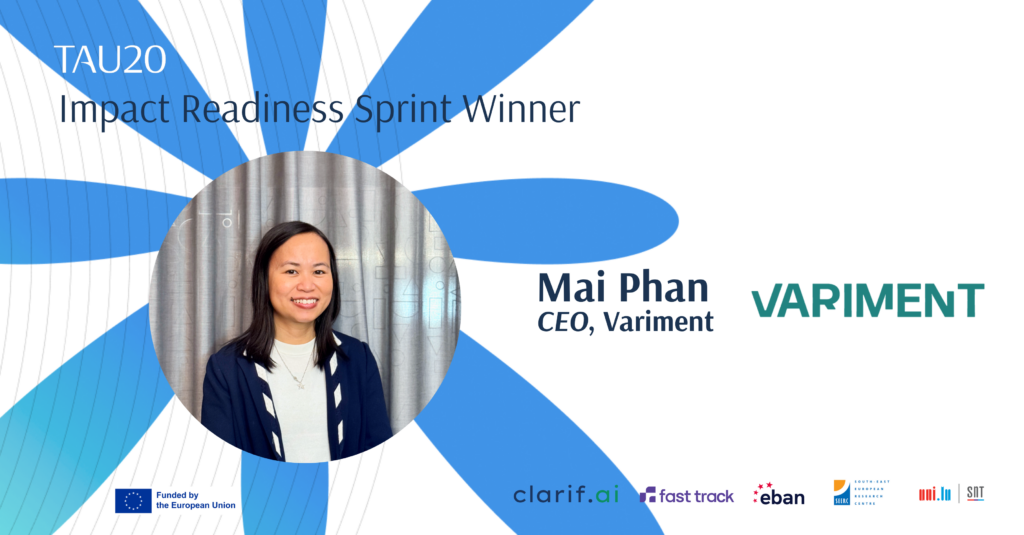
At Tau20, we were excited to connect with Variment, a Norway-based startup developing digital role-play simulations for communication training in healthcare and social services. Variment’s AI-powered role plays allow learners to practise difficult conversations, receive structured feedback, and improve empathy and interpersonal communication in a safe training environment. The company positions its solution around care quality, safer interactions, cultural sensitivity, and scalable training for educational institutions, healthcare providers, and social-service organizations.
The key question quickly became: how can this strong social-impact potential be translated into measurable impact evidence that investors, public funders, and institutional customers can rely on?
“What I like is that the tool makes it easy and quick to map out our impact areas. I think if we didn’t have the tool, we would have spent a lot of time mapping our impact.”
– Mai Phan – CEO
Tau20 Impact Readiness Sprint Participant
First, Tau20’s AI researched and pre-structured information on Variment and its solution. We then iterated with expert input and the company’s own materials to map Variment’s impact logic primarily to SDG 3 (Good Health and Well-being), especially health workforce development, care quality, and patient safety. There are also clear co-benefits for SDG 4 (Quality Education), because the product strengthens professional learning, and SDG 8 (Decent Work and Economic Growth), because better communication and emotional preparedness can support staff retention, reduce training costs, and improve workplace resilience.
The impact logic is straightforward but powerful: AI role-play simulations -> repeated practice and feedback -> stronger communication and empathy -> better care interactions, higher staff confidence, and lower organizational costs from avoidable errors, training inefficiencies, sick leave, and turnover.
Variment’s deck already provides early evidence of user value: more than 200 people across six healthcare and social-service organizations have tried the product; 89% reported higher self-confidence as healthcare professionals, 86% said it sharpened their communication skills, and 81% felt better prepared for real-world healthcare scenarios. For impact investors, this is a promising starting point because the company can connect usage data, learning outcomes, and organizational value in a measurable way.
Tau20 uses the established IRIS+ logic as a foundation and combines it with AI-supported metric matching. For Variment, the goal is to move from broad claims such as “improves communication” or “supports care quality” toward a compact and reportable metrics set that is realistic for a startup to collect.
– Health and care workers trained: Number of healthcare and social-service professionals, students, or staff completing Variment simulations. Variment already links this to IRIS+ OI4229 and targets 2,000 workers trained in 2026.
– Training hours delivered: Total hours of simulation-based communication training completed. Variment targets 4,000 training hours in 2026.
– User satisfaction and recommendation rate: Share of users recommending the training or rating it as useful; Variment targets more than 80%.
– Communication confidence improvement: Pre/post change in self-rated confidence in difficult conversations, empathy, or patient/service-user interactions.
– Communication skills improvement: Assessment-based or rubric-based change in communication quality after simulations.
– Organizational outcomes: Where customers can provide data, track changes in training time, onboarding costs, sick leave, turnover, incident reports, or complaint rates.
– Equity and cultural fit: Number and share of customized simulations reflecting local language, role context, and cultural norms.
For Variment, impact potential should be expressed primarily in people trained and training hours delivered, rather than in tonnes of CO2e. The most relevant impact pathways are improved care quality, stronger communication and empathy, better preparedness for difficult conversations, and potentially lower training costs, sick leave, turnover, incidents, or complaints where customer data allow these outcomes to be tracked.
Varimentidentifies a global impact potential of 57.9 million health and care workers. This should be communicated as the broad addressable workforce that could benefit from simulation-based communication training, not as a near-term adoption forecast.
A realistic global at-scale scenario for investor communication would be more conservative: 150,000-400,000 workers trained by 2030, corresponding to roughly 0.26%-0.69% of the global addressable health and care workforce. This range is consistent with Variment’s own 2030 target of 364,000 workers across Norway, the UK, and the U.S., while allowing the global figure to remain a broader long-term opportunity.
In practical impact terms, 150,000-400,000 workers trained would translate into approximately 300,000-800,000 training hours if each learner completes around two hours of role-play simulation. The impact claim should remain focused on training reach and learning outcomes until stronger customer-level evidence links Variment use to reduced sick leave, lower turnover, fewer communication-related incidents, or improved patient and service-user experience.
For Norway specifically, a realistic national at-scale scenario would be around 15,000-35,000 health and social-care workers trained by 2030, equivalent to roughly 30,000-70,000 training hours if each learner completes about two hours of simulation training. This treats the full Norwegian health and social-care workforce as the addressable ceiling, but assumes adoption through selected municipalities, education providers, and care organizations rather than nationwide coverage.
The strongest impact case for Variment is that it addresses a high-stakes capability gap: communication, empathy, and interpersonal skill in care settings. These skills directly affect patient and service-user experience, staff confidence, training quality, and organizational resilience.
For investors, the core logic is not simply that Variment uses AI. It is that AI makes high-quality role-play practice more scalable, repeatable, and measurable. Traditional role-play training is valuable but often resource-intensive. Variment can help institutions offer realistic practice at lower marginal cost, generate structured feedback, and create a data trail for learning and impact reporting.
This is where Tau20 helps: mapping the SDGs, translating the theory of change into measurable indicators, separating technical potential from realistic adoption scenarios, and creating a clearer investor-facing evidence roadmap.
Finally, Tau20 can issue an Impact Readiness Index (IRX) result for Variment, packaged with a draft metrics plan and evidence roadmap. This can support impact VC diligence, public funding applications, and customer-facing reporting by making Variment’s social value proposition more transparent.
For Variment, the next evidence step is clear: continue collecting user-level learning outcomes, add pre/post measures where possible, and work with pilot customers to connect simulation training to organizational outcomes such as training efficiency, staff confidence, patient/service-user experience, and avoidable communication-related incidents.