
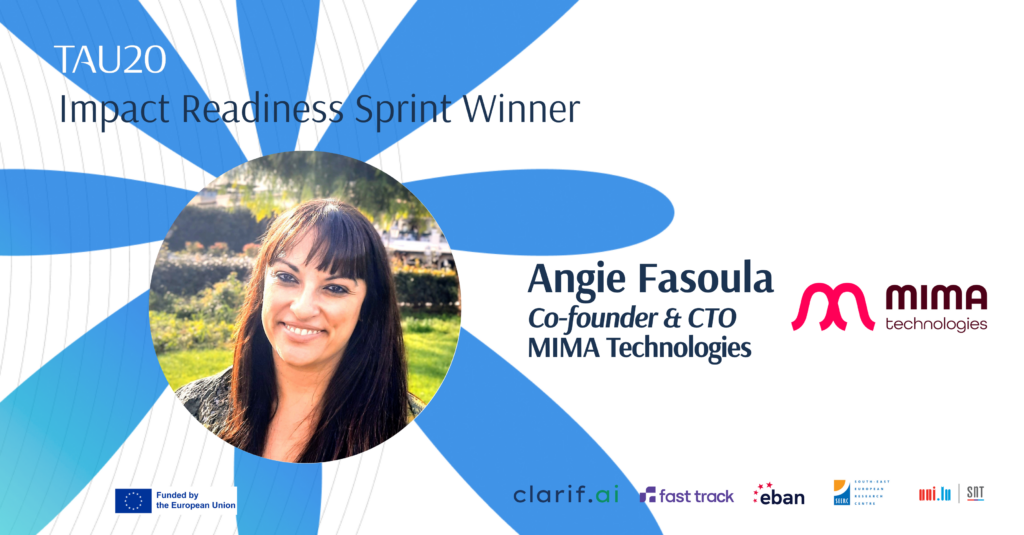
By Dr. Angie Fasoula
Breast cancer remains one of the most urgent global health challenges. In 2022, an estimated 2.3 million women were diagnosed with breast cancer worldwide and around 670,000 women died from the disease. The diagnostic challenge is particularly acute for women with dense breast tissue, where conventional x-ray mammography can be less sensitive because dense tissue can mask tumors.
At Tau20, we were excited to connect with MIMA Technologies P.C., an Athens-based deep-tech startup developing microwave breast imaging for safer and more inclusive breast diagnostics. MIMA’s solution aims to provide ionizing radiation-free, no-compression, no-contrast agent breast scans, with 3D breast image reconstruction and automated reporting of Regions-Of-Interest (ROIs) and malignancy scoring. The company positions its first indication as supplemental imaging after first-line screening with 2D x-ray mammography, especially for inconclusive or suspicious findings in dense breasts.
The key question quickly became: how can MIMA’s clinical and technological promise be translated into quantified impact evidence that investors, grant providers, and healthcare partners can understand?
“The experience with testing the beta version of the TAU20 AI tool was really insightful for our startup. The tool is very intuitive, requiring a short time to get acquainted with the available functionalities and output a meaningful quantified global impact potential for the company’s activity. It provided us with a clear impact classification and a very relevant list of IRIS+ aligned KPI’s to measure our impact as the business evolves and efficiently communicate it to investors.”
– Dr. Angie Fasoula, Co-founder & CTO, MIMA Technologies
Tau20 Impact Readiness Sprint Participant
First, Tau20’s AI researched and pre-structured information on MIMA Technologies and its microwave breast imaging solution. Together with the founders’ own evidence base, this helped map MIMA’s impact primarily to SDG 3 (Good Health and Well-being), especially Target 3.4 on reducing premature mortality from non-communicable diseases.
The impact logic is direct: safer and more comfortable supplemental imaging can improve access to repeated breast assessment; better visibility in dense breast cases can support earlier diagnosis; earlier diagnosis can reduce treatment delays, lower mortality risk, and improve patient outcomes. MIMA also has secondary links to SDG 9 (Industry, Innovation and Infrastructure) through deep-tech diagnostic innovation, and SDG 12 (Responsible Consumption and Production) through the potential avoidance of ionizing radiation and specific hazardous materials in medical imaging pathways.
Tau20 uses the established IRIS+ framework as a foundation and combines it with AI-supported metric matching. For MIMA, this means moving from broad claims such as ‘safer breast imaging’ or ‘earlier diagnosis’ toward a focused metrics set that can be tracked as the business evolves.
A first Tau20-style metrics set could include: patients scanned with the MIMA device; number and share of dense-breast or inconclusive mammography cases assessed; number of suspicious findings escalated for further diagnostic workup; earlier-stage diagnoses supported; radiologist reading time saved through automated reporting; and scans performed without ionizing radiation, compression, or contrast agent.
These metrics can then be connected to IRIS+ aligned indicators around healthcare access, oncology diagnostics, technology deployment, operational efficiency, and patient outcomes. The result is not only an impact story but an evidence roadmap that MIMA can use in investor conversations, grant applications, clinical partnerships, and later reimbursement discussions.
MIMA’s deck estimates a global impact potential of around 450,000 breast cancers diagnosed earlier per year, corresponding to roughly 20% of new breast cancer cases globally, and around 40,000 breast cancer deaths avoided per year, corresponding to roughly 6% of global breast cancer deaths. These figures should be treated as long-term global potential rather than near-term forecast, because the pathway depends on regulatory clearance, clinical validation, reimbursement, adoption by imaging centers, and integration into supplemental screening workflows.
For Europe, where MIMA focuses at first, GLOBOCAN 2022 reports 557,532 new breast cancer cases and 144,439 breast cancer deaths. Applying MIMA’s proportional global logic gives a technical European ceiling of roughly 110,000 earlier diagnoses and 8,600 deaths avoided per year; a more realistic Europe-only at-scale scenario, assuming adoption in a subset of suitable dense-breast and inconclusive supplemental-imaging pathways, would be around earlier diagnoses and deaths avoided annually.
Finally, Tau20 summarized an Impact Readiness Index (IRX) result for MIMA Technologies, packaged with a draft metrics plan and an evidence roadmap. This can support impact VC diligence, health innovation funding, and public grant applications by making the company’s medical and social value proposition more transparent.
For MIMA, the next evidence step is clear: continue clinical validation, document performance in dense-breast and supplemental imaging use cases, quantify workflow efficiency gains, and track how earlier detection potential translates into measurable patient and healthcare-system outcomes.
Finally, Tau20 issued an Impact Readiness Index (IRX) view for Kodnyx, packaged with a draft metrics plan and evidence roadmap. For an early-stage deep-tech company, this is especially valuable because much of the impact is still model-based before broad commercial deployment. The IRX helps distinguish between current evidence, pilot-stage assumptions, and long-term impact potential.
For Kodnyx, the next evidence step is clear: validate the model through paying industrial pilots, convert pilot data into repeatable optimization logic, and document the difference between baseline AC architectures and optimized AC/DC/hybrid alternatives. Once pilot sites generate measured electricity data, Kodnyx can move from scenario-based impact potential toward increasingly verified impact performance.