
By Tomas Novotny
Mental health, cognitive fatigue, and disengagement are no longer “soft” workplace topics. They are major productivity, learning, and human-capital risks. Globally, depression and anxiety are associated with an estimated 12 billion lost working days and around US$1 trillion in lost productivity each year. At the same time, employee engagement remains under pressure, with Gallup reporting another decline in global engagement in 2025. Sources: WHO mental health at work; Gallup global employee engagement.
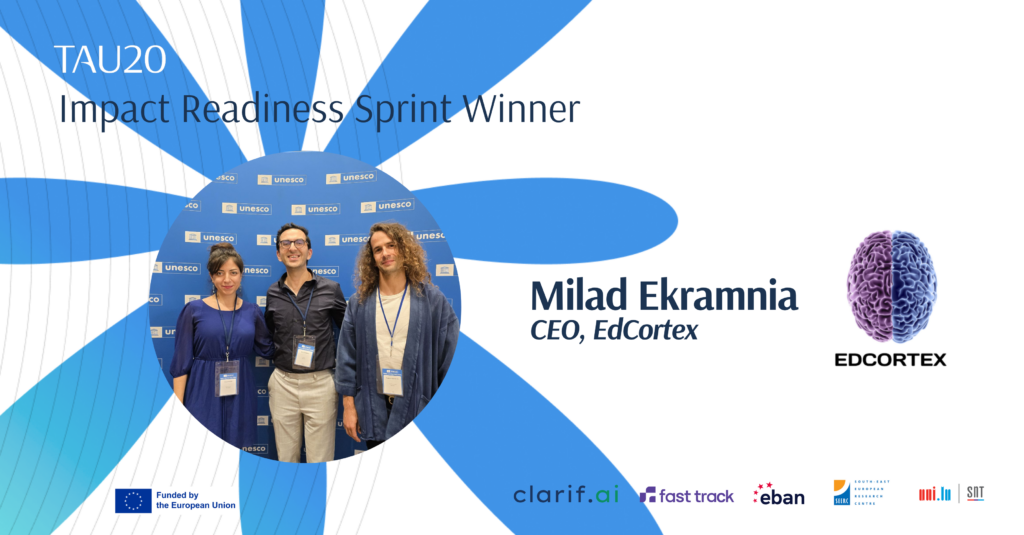
At Tau20, we were excited to connect with EdCortex, a cognitive-intelligence platform focused on workforce cognitive optimization, predictive mental-health support, and hyper-personalized upskilling. EdCortex’s own materials position the company around cognitive profiling, personalized micro-interventions, predictive alerts on cognitive fatigue, and profile-specific micro-trainings, with the broader goal of optimizing employee performance while supporting mental health. Public information from EdCortex similarly describes AI-driven cognitive profiling, predictive mental-health optimization, and personalized learning support.
The key question quickly became: how can this promising cognitive and learning technology be translated into investor-ready impact evidence? website.
“I found Tau20 an excellent platform. It transforms qualitative impact goals into quantitative scores, providing the data-driven evidence required to satisfy ESG investors. By automating the mapping of operations to UN SDGs and global frameworks, it removes much of the resource-heavy reporting burden typically faced by startup teams. This creates a distinct competitive advantage: turning social and environmental outcomes into transparent assets for investor due diligence.”
– EdCortex
Tau20 Impact Assessment Participant
First, Tau20’s AI researched and pre-structured information on EdCortex and its solution. We then iterated with expert input and company information to map EdCortex’s impact logic primarily to SDG 3: Good Health and Well-being, SDG 4: Quality Education, and SDG 8: Decent Work and Economic Growth.
This mapping reflects three central impact pathways:
– Better cognitive support → reduced overload and fatigue → improved employee well-being
– Personalized micro-training → stronger learning engagement → more effective upskilling
– Predictive alerts and timely interventions → fewer errors and better work performance → higher organizational productivity
This positioning is also consistent with EdCortex’s broader ecosystem role: UNESCO lists EdCortex as part of its Global Education Coalition and describes its learning platform, API platform, and workforce cognitive optimization solution as focused on hyper-personalized learning pathways and cognitive-driven support. Source: UNESCO Global Education Coalition: EdCortex.
Tau20 uses the established IRIS+ logic as a foundation and combines it with AI-supported metric matching. For EdCortex, this means moving from broad claims such as “improves well-being” or “supports upskilling” toward a tighter and more reportable set of impact metrics.
A first Tau20-style metrics set could include:
– Employees reached with cognitive profiling and personalized support: Number of employees using EdCortex’s cognitive optimization or learning tools.
– Micro-interventions delivered and completed: Number and completion rate of personalized nudges, reinforcements, and micro-trainings.
– Learning engagement improvement: Change in usage, completion, or retention indicators compared with baseline learning-platform engagement.
– Cognitive fatigue risk reduction: Change in fatigue-risk signals or overload indicators before and after implementation.
– Workplace well-being improvement: Change in validated well-being, stress, or mental-health proxy indicators, where clients collect such data responsibly and ethically.
– Productivity or error-related improvement: Change in work-performance, error, rework, or incident indicators in use cases where EdCortex is deployed in high-stakes operational environments.
The strongest impact case for EdCortex is not simply that it uses AI in learning or HR. It is that the company sits at the intersection of three measurable problems: workplace mental health, ineffective upskilling, and cognitive performance risk.
That matters because ESG and impact investors increasingly need more than a compelling narrative. They need evidence that a startup can define who benefits, how outcomes change, and which data can be collected repeatedly. In EdCortex’s case, the “impact logic of change” can be summarized as:
– Cognitive profiling → personalized support → improved learning and reduced fatigue → better well-being and productivity outcomes
This is exactly where Tau20 helps: translating a complex product into a structured impact model, matching it to SDGs and global frameworks, and turning qualitative claims into measurable indicators.
Finally, Tau20 can issue an Impact Readiness Index (IRX) result for EdCortex, packaged with a draft metrics plan and an evidence roadmap. This can support impact VC diligence, ESG-oriented fundraising, and public funding applications by making the company’s social and human-capital value proposition more transparent.