
By Mirko Hirschmann
Electrification is accelerating across industry, buildings, data centers, logistics, and mobility. This creates an enormous climate opportunity, but also a design challenge: electricity demand is rising fast, and many energy-intensive facilities still rely on electrical architectures that were not built for today’s mix of DC loads, photovoltaics, batteries, power electronics, and digital infrastructure.
The International Energy Agency describes energy efficiency as the “first fuel” in clean-energy transitions because it can reduce emissions, lower bills, and strengthen energy security. In 2024, global electricity consumption grew strongly, with buildings and industry together accounting for most of the growth in electricity demand.
The gap between the DC devices industry increasingly relies on and the AC infrastructure that still feeds them is an underutilized efficiency lever in this transition — modest per device, meaningful at scale.
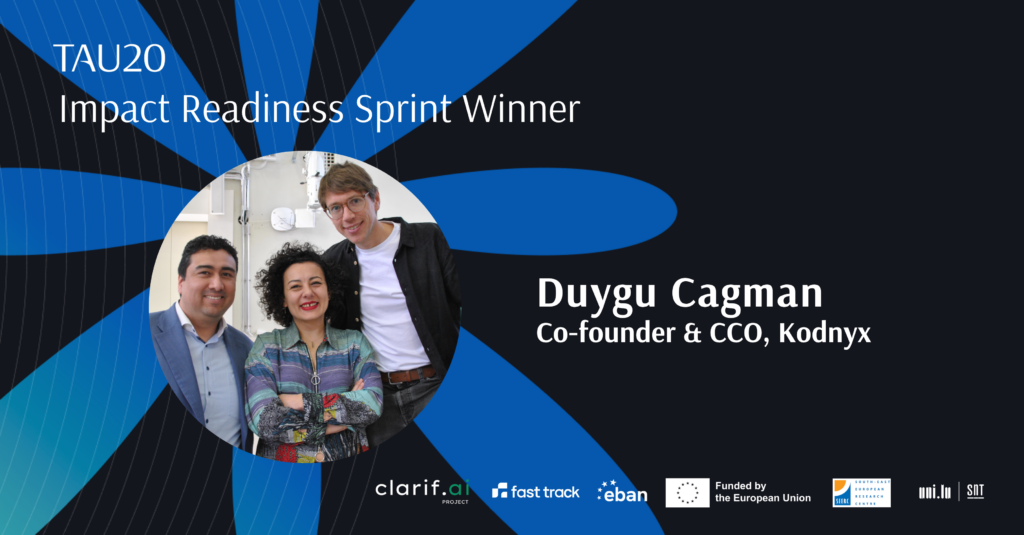
At Tau20, we were excited to connect with Kodnyx, a Berlin-based deep-tech B2B startup building software for electrical architecture optimization. Kodnyx helps electrical planners and industrial facilities compare AC, DC, and hybrid layouts before investments are made, identifying the topology that minimizes conversion losses and improves facility ROI. The company’s materials frame the opportunity clearly: electrical architecture optimization can unlock up to 35% in energy savings for electricity-intensive facilities.
The key question quickly became: how can this technical potential be translated into impact evidence that investors, pilots, and public funders can rely on?
“Tau20 makes comprehensive research about the business’s potential impact for sustainability goals much easier. The tool identifies potential impact metrics to follow during business operations. It is a great advantage for founders to keep track of these metrics and to report back to stakeholders. Having the list of potentially relevant investors in that field is also very helpful”
– Duygu Çağman, Kodnyx
Tau20 Impact Readiness Sprint Participant
Tau20 uses the established IRIS+ framework and additionally AI-enhanced metric matching to create a focused set of indicators that a startup like Kodnyx can actually report. For Kodnyx, this means moving from a general energy-efficiency claim to a measurable, facility-level evidence model.
– Energy savings from manufacturing processes (kWh or % reduction): modeled and then measured facility-level electricity savings compared with the AC legacy or baseline architecture.
– GHG emissions avoided (tCO2e): energy savings multiplied by local or market-specific grid emission factors.
Technology type / architecture type: share of projects focused on AC, DC, or hybrid electrical architecture optimization.
– Material efficiency / waste reduced: reduction in cable, copper, or other material intensity compared with the baseline design.
– Facilities assessed and optimized: number of industrial, commercial, port, warehouse, or data-center facilities assessed through Kodnyx’s software.
Based on the scenarios in the Kodnyx Tau20 pitch deck, the per-facility impact potential is in the range of 15-35% permanent electricity savings. Applying this range to global industrial and commercial electricity demand, with a global average grid intensity factor, yields an indicative ceiling of roughly 1.07–2.49 Gt CO₂e avoided per year globally, and on the order of 62–267 Mt CO₂e per year at the European scale. These figures are scenario-based maxima, not measured outcomes or deployment forecasts: they assume broad applicability across eligible facilities and serve to frame the order of magnitude. Translating this ceiling into realized impact will depend on addressable market share, deployment pace, and facility-level validation — which is precisely what pilots and the IRIS+ metric set above are designed to evidence.
The important point is that Kodnyx’s impact model is highly measurable: each customer project can generate a baseline design, optimized design, and modeled savings. That creates a clear pathway from technical optimization to impact verification.
Tau20 uses the established IRIS+ framework and additionally AI-enhanced metric matching to create a focused set of indicators that a startup like Kodnyx can actually report. For Kodnyx, this means moving from a general energy-efficiency claim to a measurable, facility-level evidence model.
– Energy savings from manufacturing processes (kWh or % reduction): modeled and then measured facility-level electricity savings compared with the AC legacy or baseline architecture.
– GHG emissions avoided (tCO2e): energy savings multiplied by local or market-specific grid emission factors.
Technology type / architecture type: share of projects focused on AC, DC, or hybrid electrical architecture optimization.
– Material efficiency / waste reduced: reduction in cable, copper, or other material intensity compared with the baseline design.
– Facilities assessed and optimized: number of industrial, commercial, port, warehouse, or data-center facilities assessed through Kodnyx’s software.
Based on the scenarios in the Kodnyx Tau20 pitch deck, the per-facility impact potential is in the range of 15-35% permanent electricity savings. Applying this range to global industrial and commercial electricity demand, with a global average grid intensity factor, yields an indicative ceiling of roughly 1.07–2.49 Gt CO₂e avoided per year globally, and on the order of 62–267 Mt CO₂e per year at the European scale. These figures are scenario-based maxima, not measured outcomes or deployment forecasts: they assume broad applicability across eligible facilities and serve to frame the order of magnitude. Translating this ceiling into realized impact will depend on addressable market share, deployment pace, and facility-level validation — which is precisely what pilots and the IRIS+ metric set above are designed to evidence.
The important point is that Kodnyx’s impact model is highly measurable: each customer project can generate a baseline design, optimized design, and modeled savings. That creates a clear pathway from technical optimization to impact verification.
Kodnyx sits in a highly specific white space between conventional energy management and electrical design. Most energy-efficiency tools focus on audits, monitoring, or renewables integration. Traditional electrical design tools support engineering work, but they do not necessarily compare AC, DC, and hybrid architectures as an optimization problem. Kodnyx’s proposition is to make this comparison faster, more systematic, and more accessible for electricity-intensive facilities.
This is consistent with a broader shift in industrial energy systems. The Open Direct Current Alliance highlights the potential of DC technology for efficient renewable integration, lower resource consumption, and more stable industrial power systems. Fraunhofer IPA similarly describes direct-current factory concepts as a route toward more efficient and sustainable production-site power supply. Kodnyx’s contribution is to turn that specialist engineering knowledge into scalable software workflows.
Finally, Tau20 issued an Impact Readiness Index (IRX) view for Kodnyx, packaged with a draft metrics plan and evidence roadmap. For an early-stage deep-tech company, this is especially valuable because much of the impact is still model-based before broad commercial deployment. The IRX helps distinguish between current evidence, pilot-stage assumptions, and long-term impact potential.
For Kodnyx, the next evidence step is clear: validate the model through paying industrial pilots, convert pilot data into repeatable optimization logic, and document the difference between baseline AC architectures and optimized AC/DC/hybrid alternatives. Once pilot sites generate measured electricity data, Kodnyx can move from scenario-based impact potential toward increasingly verified impact performance.